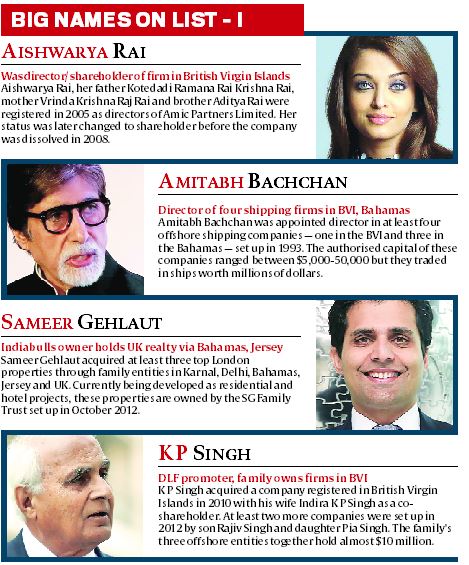
Two years before ABCL: 4 shipping firms in tax havens, one link — Amitabh Bachchan

Amitabh Bachchan was managing director of shipping companies set up 23 years ago. The other directors were representatives of firms that provide corporate and financial services.


Amitabh Bachchan and family did not respond to repeated emails sent to them and phone calls made to their mobile numbers, Mumbai residences and the AB Corporation office for over a week.Amitabh Bachchan and family did not respond to repeated emails sent to them and phone calls made to their mobile numbers, Mumbai residences and the AB Corporation office for over a week.Two years before he launched Amitabh Bachchan Corporation Limited (ABCL) in 1995, the Bollywood legend was appointed director in at least four offshore shipping companies.
Records of international law firm Mossack Fonseca, reviewed by The Indian Express, and subsequent inquiries show that the four companies, in which Bachchan was appointed director, were registered in tax havens — one in the British Virgin Islands and three in the Bahamas in November 1993.
Amitabh Bachchan, Panama Papers
The authorised capital of these companies — Sea Bulk Shipping Company Ltd (BVI), Lady Shipping Ltd, Treasure Shipping Ltd and Tramp Shipping Ltd (Bahamas) — ranged between a modest $5,000-50,000 but they traded in ships worth millions of dollars.
Bachchan was also managing director of all four companies. The other directors were representatives of firms that provide corporate and financial services. In all four cases, Warrant Secretaries Limited was appointed company secretary. Warrant Nominees Ltd and Warrant Services Ltd were issued 500 shares each.
All four companies were set up by founding directors Umesh Sahai and David Michael Pett who represented Jersey-based City Management Limited. Bachchan was appointed additional director in the very first board meeting of each company. The father-son duo of Trevor Robinson Donnelly and John Trevor Greer Donnelly, both financial consultants, were also made additional directors.
On December 15, 1994, Tramp Shipping Ltd (Bahamas) signed an investment agreement — deed of covenant — with Dallah Al-Baraka Investment Company Ltd (DAICO) of Jeddah-based Dallah Al-Baraka Group. An MF entry dated January 6, 1995 shows that a total of $1.75 million was advanced by DAICO to Tramp.
Panama Papers, Panama Papers India, Amitabh Bachchan, Mossac Fonseca, Amitabh Bachchan ABCL, Amitabh Bachchan Corporation Limited, Sea Bulk Shipping Company, Lady Shipping Ltd, Treasure Shipping, DLF panama papers Mossack Fonseca, Mossack Fonseca leak, offshore money, black money, express exclusive, indian express panama paper exclusive, India newsMF records the resignation of Bachchan from Tramp Shipping’s board.
Along with the deed of covenant, the two companies also signed “a first priority deed of assignment of freight and earnings” and a “pledge and deposit agreement”. The latter was also signed by Constellation Ship Management (Bahamas) Ltd, owned by Captain Mehernoosh R Khajotia, as warrantor. The same day, on December 15, 1994, all 1,000 shares of Tramp Shipping Ltd was transferred to Constellation Ship Management Ltd (later renamed Constellation Shipping Ltd).
Khajotia shifted his base to India in 1998 and died in 2006. But a dispute between his Mumbai-based Polaris Group and DAICO reached the Bombay High Court in 2008.
Admitting a petition on December 17, 2009, the High Court noted that Khajotia owned Constellation Shipping (Bahamas), which “some time prior to 2000” was financed by DAICO for acquiring five ships. According to the petitioner, a group company of DAICO, the loans for three vessels were repaid and the outstanding debt of Constellation was $2.5 million.
Tramp Shipping Ltd had an authorised capital of $5,000. In September 1997, records show, Bachchan along with other directors of Tramp Shipping, resigned from the board. The company replaced them with directors provided by MF and, in November, sold a ship — MV Mattz Tramp — for over $2 million.
RESPONSE: Amitabh Bachchan and family did not respond to repeated emails sent to them and phone calls made to their mobile numbers, Mumbai residences and the AB Corporation office for over a week. An AB Corp executive confirmed receipt of the email from The Indian Express on March 28.

In oil-for-food shadow, Benazir Bhutto set up a firm too

A committee set up by the United Nations under former head of US federal reserves Paul Volker found in 2005 that Petrofine FZC paid US$ 2 million commission to the regime of Saddam Hussein to win oil contracts worth US$115-145 million.


Former Pakistan prime minister late Benazir Bhutto, her aide Abdul Rehman Malik and nephew Hassan Ali Jaffery Bhutto set up a company, Petroline International Inc, in the British Virgin Islands in 2001. The trio were later accused of bribing the Iraqi government to bag contracts under the United Nation’s oil-for-food programme for a similarly named company Petrofine FZC, set up in Sharjah in 2000.
A committee set up by the United Nations under former head of US federal reserves Paul Volker found in 2005 that Petrofine FZC paid US$ 2 million commission to the regime of Saddam Hussein to win oil contracts worth US$115-145 million. In 2006, Pakistan’s National Accountability Bureau claimed that Petroline FZC was owned by Bhutto, Malik and Ali Jaffery. Bhutto and her Pakistan Peoples Party denied the charges.
International law firm Mossack Fonseca’s (MF) records reviewed by The Indian Express show that the trio —Bhutto, Malik and Jaffery — set up a similarly named company in the British Virgin Islands but the political sensitivity of the association made MF eventually back out, saying that “the partners of the firm have decided not to accept Mrs Bhutto as a client”.
Soon after the UN oil-for-food scam unravelled, a defiant Benazir was assassinated while electioneering in 2007. Her aide Malik is now a senator and a senior member in PPP’s Central Executive Committee. Earlier, an additional director in the Federal Investigation Agency, he served Benazir in Pakistan and in exile.
Approached by London law firm Richard Rooney and Co, MF-BVI incorporated Petroline International Inc in the British Virgin Islands on September 7 2001 as a standard shelf company with an authorised capital of US$ 50,000 (US$1 per share).
The names of Bhutto, Malik and Jaffery as directors and shareholders did not surface until September 28, 2001 when MF-London asked MF-BVI to issue 17,000 shares to Benazir Bhutto and 1,65,000 each to Abdul Rehman Feroz Malik and Syed Hassan Ali Jaffery. Incidentally, this share structure — 34-33-33 percent among Bhutto, Malik and Jaffery — was identical to the alleged shareholding of Petroline FZC.
The Indian Express tried to contact Malik at his Pakistan number but he was unavailable. Hassan Bhutto was not available for comment.

Nawaz Sharif family owned, mortgaged 6 London properties via British Virgin Islands

Four properties were mortgaged to the Deutsche Bank (Suisse) SA for a loan of GBP 7 million

The Indian Express, 3 April 2016

Hussain and Hasan Nawaz Sharif, and Mariam Safdar, the sons and daughter of Pakistan Prime Minister Nawaz Sharif, set up at least four offshore companies in British Virgin Islands (BVI). These companies owned at least six upmarket properties overlooking London’s Hyde Park.
Thousands of Mossack Fonseca (MF) documents reviewed by The Indian Expressand subsequent enquiries reveal that the Sharif family mortgaged four of these properties to the Deutsche Bank (Suisse) SA for a loan of GBP 7 million and the Bank of Scotland part financed the purchase of two other apartments.
While the Pakistani media had connected some of these BVI companies and London properties to the Sharif family in the past, Nawaz Sharif has denied ownership of any such property. Hussain and Hasan Nawaz Sharif, and Mariam Safdar, did not respond to queries emailed to them by The Indian Express.
Nescol Limited and Nielson Holdings Limited were incorporated in BVI in 1993 and 1994, respectively, and were held by one bearer share each. In February 2006, Mariam Safdar signed a resolution of Nescol Limited as the “sole (bearer) shareholder”. MF was appointed as the registered agent through Minerva Trust which described Mariam Safdar as the beneficial owner of both companies.
SharifDAUGHTER
In August 2008, BVI law firm Farara Kerins issued two legal opinions. As Nescol’s property, it identified “leasehold properties known as 17… and 17A Avenfield House, 117 to 128 Park Lane, London, W1K 7AH and car parking space 9 and box room 6… registered… with Title Numbers NGL342976 and NGL342977 respectively”. As Nielson’s property, it identified two titles of 16 and 16A Avenfield House.
In October 2008, Deutsche Bank (Suisse) SA sanctioned a “cross collateralised”loan of up to GBP 7 million —GBP 3.5 million to Coomber Group Inc (BVI) and GBP 1.75 million each to Nescol and Nielson —against the four Avenfield House titles. Earlier, in June 2007, Sharif’s elder son Hussain and daughter Mariam signed the mortgage agreement for Coomber Group Inc.
SharifSON&Dotty
Following queries from the Financial Investigation Agency in 2012, MF invoked the Anti-Money Laundering and Terrorist Financing Code of Practice (2008) to grill Minerva for information about Nescol and Nielson. In June 2012, Minerva Trust & Corporate Services Ltd revealed that both companies “owned a UK proper each” —16 and 17 Avenfield House —and were “owned by the same beneficial owner Mariam Safdar”.
Adding that the companies had a loan account with Deutsche Bank Geneva, Minerva said that “neither property is rented and only occupied by the owner and her family.” MF passed on the details to FIA. But assured by Minerva that they were aware of the client’s Politically Exposed Person (PEP) status, MF ordered compliance monitoring every six months and decided not to provide nominee (proxy) directors or shareholders for Mariam’s companies.
Hasan, Nawaz Sharif’s younger son, also owned at least one company in BVI. Hangon Properties Holding Limited was incorporated in BVI in February 2007 with an authorised capital of US$ 50,000.
SharifTheOtherSon
In June 2007, 10 shares were issued to Cascon Holdings Establishment Limited (Liberia). The next month, the shares were transferred to Hasan Nawaz Sharif for GBP 5.5 million and the Bank of Scotland sanctioned a mortgage loan of unknown amount to Hangon “to assist in the purchase of the property (Flat Nos 3 and 4 ) at 1 Hyde Park Place, London.”
In August 2007, MF was told that Hasan had purchased the issued share capital in Hangon from Cascon Holdings (Liberia). Asked to take a call by MF’s compliance department in October 2007, Jurgen Mossack wrote: “Si, correcto. NO aceptar el cliente en forma directa, por mi parte (Yes, correct. As far as I’m concerned, DON’T accept the client directly).”

Indians in #PanamaPapers list: Aishwarya Rai, Amitabh Bachchan, KP Singh, Iqbal Mirchi, Adani elder brother

Biggest leak of over 11 million documents of Panama law firm features over 500 Indians linked to offshore firms, finds 8-month investigation by a team of The Indian Express led by Ritu Sarin, Executive Editor (News & Investigations).

Ritu Sarin, P Vaidyanathan Iyer, Jay Mazoomdaar

The Indian Express, 3 April, 2016

Last year, it was Swiss Leaks, a global list with over 1,100 Indians with secret bank accounts in HSBC Geneva, which shaped the debate over black money parked overseas. Now come The Panama Papers. 
More than 11 million documents from the secret files of Mossack Fonseca, a law firm headquartered in tax haven Panama, known for its factory-like production of offshore companies for its worldwide clientele of the well-heeled. These records reveal a list of individuals who have paid the firm — and bought the benefits of the secretive, lax regulatory system in which it operates — to set up offshore entities in tax havens around the world. And Mossack Fonseca’s eagerness to meet their demands, each one for a fee, that helps mask real ownership but still show compliance.
Over 500 Indians figure on the firm’s list of offshore companies, foundations and trusts. There are also 234 Indian passports (handed over by clients as part of the incorporation process), an eight-month-long investigation of over 36,000 files by The Indian Express has revealed. Of these, The Indian Express has checked the authenticity of over 300 addresses.
From film stars Amitabh Bachchan and Aishwarya Rai Bachchan to corporates including DLF owner K P Singh and nine members of his family, and the promoters of Apollo Tyres and Indiabulls to Gautam Adani’s elder brother Vinod Adani. Two politicians who figure on the list are Shishir Bajoria from West Bengal and Anurag Kejriwal, the former chief of the Delhi unit of Loksatta Party.
From Mumbai ganglord the late Iqbal Mirchi, the list includes scores of businessmen with addresses in nondescript neighbourhoods in Panchkula, Dehradun, Vadodara and Mandsaur. Addresses of individuals, in many cases, The Indian Express found out, led to physical locations, but with no trace of the individual. Or, as in one case, belonged to a tenement in a chawl in Mumbai. Not just individuals, a close scrutiny of The Panama Papers by The Indian Express also reveals details of hitherto unknown deals, in some cases involving the government, too.
These include cricket franchise deals and, in several cases, linkages to those who have previously been under CBI or Income Tax scrutiny. As per RBI norms, no Indian citizen could float an overseas entity before 2003 — in 2004, for the first time individuals were allowed to remit funds of up to $25,000 a year under the Liberalised Remittance Scheme, and this limit stands at $250,000 a year now.
But while RBI let individuals buy shares under LRS, it never allowed them to set up companies abroad, having clarified it through an FAQ mid-way in September 2010. In most of the cases in The Panama Papers, companies were set up long before the rules were changed and the purpose, experts said, was to park foreign exchange in a tax haven. It was only in August 2013 that individuals were allowed to set up subsidiaries or invest in joint ventures under the Overseas Direct Investment window. Indeed, records investigated reveal detailed correspondence between Indian tax authorities and those in British Virgin Islands, Seychelles, Panama or other tax havens seeking shareholder, bank account and asset details of offshore companies set up by Mossack Fonseca for Indians.
It is revelatory that authorities in these tax havens had no choice but to depend on Mossack Fonseca for information since, unlike India, the government is not a repository of ownership details. The Panama Papers come at a time when the Special Investigating Team (SIT) on black money headed by former Supreme Court Judge M B Shah is finalising its new action-taken report. The formation of the SIT was the very first decision taken by the Narendra Modi Government in May 2014. The treasure trove of records was accessed by Munich-based newspaper Suddeutsche Zeitung which a year ago collaborated with the International Consortium of Investigative Journalists (ICIJ) and, in turn, with over 100 media organisations to investigate its contents. 
In July 2015, The Indian Express signed an agreement with ICIJ for being the Indian partner for The Panama Papers project. Since then, a team of 25 reporters, led by the newspaper’s investigative team, joined 375 journalists in 76 countries. Scouring electronic databases of documents registered in tax havens, joining digital dots (emails, PDF and TIFF files with one document sometimes yielding attachments with hundreds of pages of correspondence, agreements and contracts), cross-referencing company data with lists of names, The Indian Express reporters did field visits across the country to check on addresses mentioned in these records. 
The Indian Express asked each one named whether they had informed RBI or the Income Tax department about these companies. The results of that investigation — that begin in a series starting today — tell a story that’s as much about draconian foreign investment laws as it’s about glaring gaps in the regulatory apparatus. 
The Mossack Fonseca data contains details of entities set up almost four decades ago from 1977 up to those registered just four months ago, that is, December 2015. Clearly, it covers the period when India began signing tax agreements with other countries to accelerate cooperation on undisclosed and untaxed assets. And the years when tracking black money has become the centre of political and economic discourse. 
The worldwide expose also comes just six months after the 90-day “compliance scheme” for declarations of offshore assets and accounts ended on September 30, 2015 and brought just Rs 3,770 crore from 637 declarants. The window now closed, strict penalties and a jail term have been announced for anyone found to have undisclosed and undeclared foreign assets and accounts. 
The Panama Papers is the third successive collaborative project done by The Indian Express with the ICIJ on offshore investments. The first was in 2013, titled “Offshore Leaks.” There were 612 Indians on that list which included two politicians who were then Members of Parliament (including Vijay Mallaya) and several top industrialists. The revelations led to several persons getting tax notices and subsequently being prosecuted for non-declaration of the offshore companies. 
The second ICIJ-The Indian Express collaboration, under the aegis of the French newspaper, Le Monde, was published in February 2015. It was called “Swiss Leaks” and contained data of HSBC (Geneva) account holders — balances dating to 2006-07 — among whom there were 1,195 Indian account holders. Significantly, this was almost double of the 628 names given by the French authorities to the Indian government in 2011 and the scope of the HSBC probe was expanded following the expose. 
Searching 36,957 Needles In An 11-million Haystack 
Given the humongous 2.6 tera byte dump size of Project Prometheus — as the investigation was aptly named — the task was cut out for the team. Tracing Indians in the database comprising over 11 million files and 2,14,488 offshore entities was akin to searching for a needle in a haystack. And all the giga bytes did not come in one go, forcing us to what management experts call ‘fix the aircraft while it flies’. 
In all, the dump finally threw up 36,957 India-related files. Online tools were created to unravel complex web-like linkages between individuals and multiple entities. Internal mails of Mossack Fonseca and legal incorporation documents attached in these revealed not only addresses and passports of individuals, but in some cases also their source of wealth and the intent in setting up offshore entities. 


MoEF’s Toyota Fortuner goes back where it should have been

It is now learnt that on December 21, Sky Packers & Movers, New Delhi, was selected on the basis of a spot quotation for a Rs 44,000-contract to transfer the Fortuner (DL 3C CC 8068) to Bhubaneswar.

The Indian Express, 31 March, 2016

A Toyota Fortuner, being used in New Delhi by Environment Minister Prakash Javadekar though it had been bought by SAIL for field inspection in Odisha by staff of the Ministry of Environment and Forests, was returned to Bhubaneswar within days of The Indian Express seeking comments from the minister last December.
The Indian Express had contacted Javadekar for comments on December 17, 2015. He sought time but neither he nor any official of his ministry replied and the report was published December 22.
It is now learnt that on December 21, Sky Packers & Movers, New Delhi, was selected on the basis of a spot quotation for a Rs 44,000-contract to transfer the Fortuner (DL 3C CC 8068) to Bhubaneswar.
The ministry did not share the file notings on the matter sought through an RTI application — it was filed on February 11 this year — but said the vehicle was “shifted out of Delhi with the approval of the competent authority”. A copy of the financial statement of the contract, obtained under RTI, stated that “spot quotations were invited after obtaining of (sic) approval of SO (GA)”. The SO (GA) refers to a section officer in the general administration division.
Neither Javadekar nor Environment Secretary Ashok Lavasa responded to emails sent Monday by The Indian Express.
In February 2015, the ministry, while granting forest clearance to SAIL’s Barsua iron mines in Odisha, asked the public sector undertaking for a vehicle that the ministry’s Bhubaneswar staff could use for field inspections.
Official records show that within four months, SAIL bought a Rs 20-lakh Toyota Fortuner for the ministry. But this SUV was not sent to the field office. It was delivered in New Delhi where it was being used by Javadekar.

AIIMS asked for IB probe to identify ‘source’ in press reports

The All India Institute of Medical Sciences sought a probe by the Intelligence Bureau (IB) into what it called leak of official documents to the media and their alleged source


The All India Institute of Medical Sciences (AIIMS) sought a probe by the Intelligence Bureau (IB) into what it called leak of official documents to the media and their alleged source. It was asked by the Ministry of Health and Family Welfare to “investigate the matter appropriately”.
On November 30, 2015, AIIMS Deputy Director (Administration) wrote to the Ministry for handing over an investigation into “leakage of official documents from AIIMS” to the IB “for identifying the unnamed source from AIIMS” cited in new reports published in The Pioneer during October-November 2015.
Citing sources, The Pioneer reporter had published several reports on alleged irregularities at AIIMS.
On January 7, the Ministry asked the institute to conduct its own probe. In a letter to the Director of AIIMS, the Ministry’s Director, Amrit Lal, stated that “the matter has been considered in the Ministry. The institute is requested to investigate the matter appropriately. This issues with the approval of Hon’ble HFM.” Six days later, the AIIMS Deputy Director, who had sought an IB probe, wrote another letter in which he alleged that the “case of media leaks of official documents by Shri Sanjiv Chaturvedi is established beyond doubt”. An Indian Forest Service officer on deputation, Chaturvedi has been having a running battle with the Ministry over alleged corruption charges. AIIMS Director M C Misra and Chandan Mitra, Editor of The Pioneer, did not respond to phone calls, text messages and emails for comment. 

How lawyer Vikram Singh Chauhan who led both assaults at Patiala court sought support on Facebook to ‘teach traitors a lesson’

Vikram Singh Chauhan’s Facebook timeline shows nine posts between February 11 and 16 in which he is urging lawyers to reach the court well in time to “demonstrate patriotism” and “teach the traitors a lesson”.

The Indian Express, 18 February, 2016


Vikram Singh Chauhan, the lawyer who led the attack on journalists and students Monday and was in the group that assaulted JNU students’ union president Kanhaiya Kumar at the Patiala House Courts Wednesday, used Facebook to mobilise support for the attacks.
Chauhan’s Facebook timeline shows nine posts between February 11 and 16 in which he is urging lawyers to reach the court well in time to “demonstrate patriotism” and “teach the traitors a lesson”. While a couple of these posts talk of taking the legal course, they also call for direct action or “face-to-face fight”.
He posted several photographs to show his links to the BJP — he is seen with several party leaders, from Rajnath Singh to J P Nadda to Kailash Vijayvargiya — and calls himself a “worker of BJP”. In other photographs, he is at an ABVP event in Delhi University last September on the eve of elections to the students’ union.
* On February 11, Chauhan made his first post on the JNU issue. Referring to JNU student Umar Khalid and others who allegedly shouted pro-Pakistan slogans, it said “time has come to send these people back to their country”. The post mentioned “legal means” to mete out justice, but also urged those who have “so far demonstrated their patriotism on social media” to get ready because “time was ripe for a face-to-face fight to teach the traitors” a lesson. He concluded the post by asking people “interested in this noble cause” to contact him.
* In a second post on February 11, he announced that Kanhaiya could be brought to the Patiala House Courts. He reminded lawyers that they “have shown their strength from time to time” and “hopefully will take good care” this time. The post ended with a vow to “eliminate every Afzal Guru born”. 
* The next post on February 12 featured four photos of Chauhan participating in a rally organised by “nationalist students”. Chauhan said the rally sent a clear message to “anti-national forces” that “patriotic youth” were “ready to make any sacrifice” for the country. 
* On February 13, Chauhan posted: “Please demonstrate your patriotism by reaching the Patiala House Courts tomorrow morning. under no circumstances can we allow these anarchist, Pakistan-supporters get bail or any relief. you are requested to reach the court in maximum numbers to teach these anti-nationals a lesson through legal means.” The post ended with ‘Doodh mange kheer denge, aage sabko pata hai.’ — a reference to the slogan ‘Doodh mangoge to kheer denge, Kashmir mangoge to chir denge’. 
* In a second post on February 13, he tagged 85 people, mostly senior functionaries of the Bar Council of Delhi. In it, Chauhan urged seniors to demand a thorough and speedy trial of the case. “We can set an example on behalf of the Bar Council at the court. and I request you to be at the court to encourage us and tell the world that Delhi lawyers are patriotic, law-abiding and legally-able to deal with such traitors.” The two posts on February 13 attracted more than 400 likes. 
* On February 15, Chauhan posted two photographs. He is seen smiling soon after his group of lawyers assaulted JNU students and journalists. The photos attracted over 650 likes and over 40 congratulatory comments. A few even proudly posted a media photo of Chauhan assaulting a student as a comment in both threads. 
* On February 16, Chauhan thanked everyone: “Today I am feeling proud to be a member of the Bar Council. from now on, only those who say ‘Jai Hind’ will stay in India. Long live lawyers’ unity. I hope I will continue to have your love and cooperation like this.” More than 200 people liked it. 
* In another post on February 16, Chauhan wrote: “I have been made the biggest goon of the country and those who are against Mother India are now heroes. If countering Leftist goons, saying ‘long live Mother India. is hooliganism, then I am a goon. I don’t care who all are barking. we are gathering again tomorrow to expose their conspiracy and.I request all of you to reach the court in maximum numbers by 10 am.” The post tagged 96 people and drew 198 likes and 70 comments. 
The next day, he was back at Patiala House Courts. And this time the group headed for Kanhaiya.

Elephants and leopards in the city: Run out of luck – and choices

Animals don’t stray and know how to be discreet. They want us to give them space and handle accidental face-offs better.

The Indian Express, 10 February, 2016


The recent headlines — a leopard ‘running amok’ in a Bangalore school or a ‘rampaging’ elephant in Siliguri — have triggered fresh debates over why wild animals are ‘straying’ into human spaces so frequently. Animals — wild or domestic — seldom, if ever, stray. Trust them to know where they are going and their ways. Try abandoning your pet miles away and see how it shows up back at home.
The leopard spotted in a school in Bangalore’s Marathahalli, for example, could not have lost its way. In all likelihood, it was using the area for a long time – roaming the city streets in the night to opportunistically prey on dogs and using the green patches around the Varthur lake as its day shelter. However discreet, the Marathahalli cat blew its cover one unfortunate morning. Both people and the animal panicked. And all hell broke loose.
Elephants obviously face a bigger challenge to stay invisible. They require a lot of food which forces them to migrate seasonally across considerable distances. The herds stick to traditional routes, and increasingly run into manmade barriers and trouble. Of course, some herds do raid villages for food and such campaigns can also get violent if the animals face aggressive resistance.
Elephants do not march in single file while migrating. They disperse to forage individually or in small groups before combining as a herd only to disperse again. It is during these dispersals that a relatively young elephant or a lone bull can find itself in unfamiliar territories — thanks to rapid changes in land use — and panic. In such situations, collective or individual memories of persecution at the hand of hostile communities, some experts claim, can make certain elephants particularly aggressive.
Across north Bengal, the elephant’s traditional migrating landscape between Sankosh (Bengal-Assam border) and Kosi (Nepal) rivers is severely fragmented by settlements, agricultural plots and military infrastructure.
The result is disproportionately high man-elephant conflict — less than 2 per cent of India’s elephant population involved in more than 20 per cent of recorded altercations.
It is difficult to theorise when we have an elephant in a city or a leopard inside a school. While dealing with emergencies, strict crowd (and media) management and professional immobilisation can reduce casualties. But unless we give the wildlife space and not panic to retaliate at the mere sight of it, only management initiatives may not be enough to reduce conflict.

Protecting the coconut tree, ground upwards

An explanation of how a highly-valued horticultural species does not need anti-felling laws but protection from sweeping changes in land use.

The Indian Express, 29 January, 2016


The Goa government’s move to allow felling of coconut trees without permission has fuelled a debate on, among other issues, the correct definition of ‘tree’. Dictionaries describe a tree as a perennial woody plant whose branches spring from and are supported by a trunk. There is no standard legal definition as different courts of law worldwide have used various yardsticks — girth, height, girth at a certain height etc.
Coconut (Cocos nucifera) belongs to the Arecaceae (palm) family. We know palms do not grow branches. But a plant does not need to qualify as a ‘tree’ to be legally protected. A number of medicinal or aromatic herbs figure on the IUCN Red list of endangered species and are duly protected.
In India, every state government draws up a list of the plant species they want to protect outside forest areas. Typically, a species is picked based on its abundance and commercial value. Rare species which are in high demand, such as red sandalwood, are naturally listed. On the other hand, felling of fast-growing timber species — eucalyptus, for instance — is usually allowed as a short-period crop. 
Horticultural species such as mango or coconut are valued for their cyclical returns and there is no incentive for a farmer to cut a fruit-bearing tree. And when old, diseased or barren trees are removed, they usually make room for the next generation of a species. That is why one needs no permission to fell coconut trees in Tamil Nadu, Kerala, Karnataka, Andhra Pradesh, and Odisha — the coastal states that contribute to over 90% of India’s coconut production. West Bengal is an exception; felling of any tree requires permission in the state. 
In 2012, the Environment Ministry’s report on Felling and Transit Regulations for Tree Species Grown on Non-forest/Private Land said that there “is a case for full exemption from regulatory regime…in all states of such… species with very sporadic distribution in forests but grown by farmers on large scale.” Species like guava, coconut, cashewnut, citrus and areca nut were named on the horticultural list recommended for exemption. 
However, enabling the farmer to decide how best to manage her orchard or plantation is not the only approach. Philippines, a country producing more coconuts than India, legislated its Coconut Preservation Act of 1995, which prohibits felling of any coconut tree not “60 years old” unless it is diseased, weak or economically non-productive. The law, however, allows felling of trees when the agricultural land devoted to coconut production is converted into an industrial, commercial or residential area. 
And therein lies the catch. 
As long as a plot is earmarked and used for agriculture, a farmer is unlikely to get rid of her coconut trees that yield fruits every year and bring money. Even if she sells off her orchard, the trees are likely to be safe as long as the new owner cannot put the land to non-agricultural use. The equation changes with a change in land use. Even the most productive coconut grove cannot be as profitable as a mega factory or a housing estate. 
In Goa, more than the government’s move to do away with permission for felling coconut trees, the timing and the circumstances of the move make it controversial. In August 2014, the state government passed the Goa Investment Promotion Act, 2014. Section 7 (3) of the Act says that once an area is notified for investment promotion, the provisions of the Regional Plan, the Outline Development Plan, all other acts of local bodies, and the land revenue code “shall cease to apply” to the notified area. 
Under this Act, the Goa government notified 12 hectares of agricultural land — a coconut orchard — for industrial use on December 21, 2015. 
The trees stand in the way of a Rs 140-crore distillery and brewery project. There is every chance that more and more orchards will make way for factories, housings or highways with similar change in land use in the near future. 
It is perhaps inevitable in a largely green state like Goa that certain natural areas will have to be sacrificed to accommodate development. By 2014, the Goa Industrial Development Corporation (Goa IDC) had already set up more than 20 industrial estates which house more than 1,600 operating industrial units over a utilised area of 1,000 hectares. Much of Goa is anyway made of laterite that lends the redness to its soil. Without exhausting such relatively unproductive areas, pushing industry to lush agricultural zones by changing land use is what makes Goa’s coconut move dangerous for the species and the Goan way of life.
Otherwise, an average Goan would be thanking the government for letting her decide how to manage her coconut trees. 

Before coconut law rewrite, Goa cleared orchard use for distillery

The project, involving construction of a Rs 78-crore distillery and a Rs 60-crore brewery, is promoted by Delhi-based Vani Agro Farms Pvt Ltd (VAFPL).

The Indian Express, 28 January, 2016


Barely three weeks before the Goa assembly cleared a change in law to allow felling of coconut trees without permission, it notified a coconut orchard for industrial use in Amdai village in Sanguem. A distillery and brewery project is to come up on this 12-hectare plot which currently has at least 500 coconut trees.
The project, involving construction of a Rs 78-crore distillery and a Rs 60-crore brewery, is promoted by Delhi-based Vani Agro Farms Pvt Ltd (VAFPL).
Sanguem councillor Prakash Gaonkar said VAFPL bought 12 hectares in Amdai from the Furtado family of Salcette in 2013. The next year, the Investment Promotion Board (IPB) of Goa, with the Chief Minister as chairman, was constituted. One of the early decisions of the board was to give in-principle clearance to VAFPL’s distillery project in January 2015.
In August 2014, the state government had enacted the Goa Investment Promotion Act, giving itself sweeping powers to notify agricultural land for industrial use. Under this Act, the IPB notified the orchard in Amdai for the distillery on December 21, 2015. 
Coconut trees on the 12-hectare plot couldn’t have been felled without permission. Because the Goa, Daman and Diu Preservation of Trees Act, 1984, had been amended in 2008 with the insertion that “the term ‘tree’ used in this Act, shall, besides other trees, include coconut trees”. 
On January 15 this year, the coconut tree was moved from Section 1 (a) to Section 12 (a) of the Act. Once notified, government permission for felling coconut trees will not be required. This change in law kicked off a storm in Goa with voices for and against it. 
Claude Alvares, Director of Goa Foundation, said: “Before the amendment, they (VAFPL) would have required permission for felling the trees. And permission could have been given for only one hectare at a time. This would have meant a total of 12 years to clear the 12-hectare plot. Now they can cut all 1,000 trees at one go for the distillery.” 
J S Tyagi, CEO of VAFPL, dismissed the claim. “It is ridiculous to suggest that we have such powers to influence the government. Anyway, we have only 800-odd trees including other species on our land and we need to cut just 100-odd coconut trees for the project,” he said.
Sanguem MLA Subhash Phal Dessai, MLA also described the “development” as a coincidence. “These are unrelated issues,” he maintained. 
Balbir Singh Malhotra of Brew Force, the company entrusted to set up and run the distillery for VAFPL in Goa, said the project was conceived in consultation with “the state establishment” well before the inception of the IPB. 
“I was requested by the local MLA to bring the distillery to Amdai to create jobs in his constituency that suffered a lot of unemployment since mining was banned. So I convinced the promoters and let go of a better option we had on the highway,” Malhotra said. 
MLA Dessai acknowledged bringing the project to his constituency. “When this opportunity came up, the same villagers who are opposing the project now had told me that they wanted employment at any cost. Even now, only one of ten Sanguem councillors is against it, that too because the company refused to meet his unreasonable demands,” he said. 
According to Tyagi, the company started applying for clearances in 2013. “Our project was cleared by the High Powered Coordination Committee (HPCC) and we also got pollution clearance after due diligence. But the HPCC was dissolved. We had to apply afresh once the IPB was set up in 2014 and then wait for land conversion,” he said. 

Ganga projects: Uma Bharti objects, Prakash Javadekar rejects

Two days after Uma flagged objections, the Environment Ministry filed the affidavit in the Supreme Court

The Indian Express, 19 January, 2016


Despite objections raised by Water Resources Minister Uma Bharti, the Environment Ministry under Prakash Javadekar has filed an affidavit in the Supreme Court allowing construction of hydel projects in the Upper Ganga stretch.
In an email to Javadekar on January 5, the day the Environment Ministry shared its draft affidavit with the Water Resources Ministry, Bharti said she was “unable to understand how the policy decision of the government as stated in the draft affidavit was arrived (at)” because an inter-ministerial committee, under Secretary, Water Resources, was still to file its report.
Listing four key areas of disagreement, Bharti requested Javadekar “not to submit the aforesaid draft affidavit” and instead ask the Supreme Court for “extension of time so as to enable the inter-ministerial committee to give its report which can form the basis of the considered policy of the government”.
The Water Resources Ministry was of the view that the Environment Ministry “draft appears to be self contradictory” and “at variance with the common understanding reached” at the Inter-Ministerial Group (IMG) set up to take a call on the matter. 
Sources said Bharti received no response to her email. On January 7, the Environment Ministry submitted its affidavit in the Supreme Court and sent a copy to the Water Resources Ministry. 
In its affidavit, the Environment Ministry referred to a conference held in Haridwar in December 1916 which was attended by “eminent social leaders, including Bharat Ratna Pandit Madan Mohan Malviya” where the consensus was to ensure that the natural flow of the river did not drop below 1,000 cusecs. 
The affidavit went on to clear three of six projects — NTPC’s 171-MW Lata Tapovan, Super Hydro’s 4-MW Khironi Ganga and the 24-MW Bhyunder Ganga — for construction. It allowed two projects — NHPC’s 195-MW Kotli Bhel IA and GMR’s 300-MW Alaknanda — with certain design modifications. The sixth project, Tehri Hydro Power’s 108-MW Jhelum Tamak — is yet to get environmental clearance. 
The IMG, with ministers of Environment, Water Resources and Power as members, was to take a call on the six hydel projects in the Upper Ganga which was struck down by the Supreme Court in the aftermath of the 2013 Uttarakhand flood. 
In 2014, the Environment Ministry even told the Supreme Court that hydel projects exacerbated the Uttarakhand disaster and a number of committees set up by the ministry since had prescribed scrapping of the six hydel projects in particular and restricting hydel projects on the Upper Ganga in general. 
At a meeting of the IMG on November 18 last year, Bharti even offered to compensate developers for the money already spent on the projects from the Nirmal Ganga funds.
In her email, Bharti pointed out four key contradictions and variances: 
* After submitting that the entire flow of the Ganga in three major contributing streams — Alaknanda, Bhagirathi and Mandakini — and that of Ganga itself after Devprayag cannot be stopped at any location, the affidavit contradicts itself by saying that “in having regard to the spirit of 1916 agreement, free, unfettered and uninterrupted flow of natural course of water up to (emphasised) the level of 1,000 cusecs. has to be maintained while designing any major structure across these tree main streams”. 
* The common understanding at the IMG was that apart from the three major streams in which flow cannot be fettered under any condition, projects in other tributaries of the Ganga can be taken up only after ensuring free, unfettered and uninterrupted flow of minimum 1,000 cusecs. This is nowhere reflected in the draft affidavit. 
* The expression “up to the level of 1,000 cusecs” is very vague and will be open to a lot of misinterpretation apart from being at variance with the common understanding of the IMG and jeopardise the requirement of e-flow in the river and its tributaries. 
* While these contradictions and variances are being submitted as the policy of the government, the IMG in its meeting dated 18-11-2015 decided to form an inter-ministerial committee under the chairmanship of Secretary, Water Resources, to give a report. The chairman of the panel sought extension of time in view of the complexity of matter and also for consideration of inclusion of a representative from Uttarakhand in view of the Chief Minister’s January 4 letter. 
“I am surprised to note that there is no mention of this development in the draft affidavit though in the previous SC hearing on 24 November 2015, extension of time was sought from the Hon’ble court precisely on this ground,” Bharti wrote, adding “I am unable to understand how the policy decision of the government as stated in the draft affidavit was arrived (at)”. 
The case comes up for hearing on January 20. 
When his comments were sought Monday, Biswanath Sinha, Joint Secretary in charge of the matter in the Environment Ministry, declined to say if Bharti’s objections were taken into account. “If it was a letter written to the Minister, only he can comment,” Sinha said. Javadekar did not respond to email queries and his office said he was not immediately available for comment.

Why beaching of whales still baffles science

Indian Express looks at the mysterious ways in which whales navigate — and sometimes get fatally disoriented and lost.

The Indian Express, 14 January, 2016


More than 100 short-finned pilot whales were stranded along a 15-km stretch of Manapad beach south of the port city of Thoothukudi (Tuticorin) in Tamil Nadu this week, and at least 60 died. How did the giant creatures show up in these shallow waters? How do whales find their way around the oceans — and why do they get beached?
What makes whales special?
Think of a hippo. Add a tail fin, flippers and the ability to stay under water for much, much longer. Take away those molars and the ability to live on land. If that’s difficult to imagine, it’s possibly because their ancestors parted ways some 50 million years ago.
Whales are fully aquatic marine mammals. They live in water, but must surface to breathe through blowholes on their heads. That is why they can’t sleep like other mammals must. Studies on captive whales show they let only one side of their brain sleep at a time, while the other works to keep the animal swimming and surfacing for air.
The other challenge is to deliver babies under water. Whales give birth with the foetus positioned for tail-first delivery, so it does not drown. Suckling the baby is to jet-spray it.
Like dolphins, whales are remarkably intelligent, and live cultural lives. They play, learn, teach, cooperate, grieve, and are known for complex vocalisation. The Cultural Lives of Whales and Dolphins, by Hal Whitehead and Luke Rendell, offers a fascinating account.
While some whales have baleen, a filter-feeder system that traps large quantities of plankton and other small prey, others have teeth. Generally, baleen whales are bigger and slower than toothed whales.
How do whales move? 
Toothed whales use echolocation, like bats. They throw sound waves through the water — and when the waves hit a prey, vessel or barrier, the whales’ brains process the echo to determine the location, size, shape and texture of the object. Baleen whales migrate over huge distances without deviating off-course for more than a single degree. Researchers from the University of Canterbury who tracked 16 humpback whales over a length of time concluded no established models of directional orientation — magnetic or solar — could explain their extreme navigational precision.
So, what then gets whales beached?
Nobody knows for sure, even though whale stranding is neither an uncommon nor a recent phenomenon. While dead individuals would naturally wash up ashore, mass beaching has baffled humans since at least 300 BC. “It is not known why they sometimes run aground on the seashore,” noted Aristotle. “It is asserted that this happens when the fancy takes them and without any apparent reason.” Centuries later, the Romans thought stranding was a whale’s punishment for offending Neptune, the god of the seas.
Okay, so what is it that we do know? 
Toothed, rather than Baleen whales, are usually stranded. Whales living in large social groups — such as the pilot whales that beached in Tuticorin — are more susceptible. An entire pod can follow a disoriented leader into shallow waters and beach themselves. Following prey-rich currents might draw whales towards land, or they might end up panicking at the presence of a mega predator such as a killer whale. Gently-sloping shorelines can deceive whales dependent on echolocation for navigation, scientists say. There’s also climate change or unnatural weather phenomena. In one recorded event, after a strong El Niño in 1982-83, a resident population of short-finned pilot whales apparently disappeared from areas along southern California. 
What about the impact of SONAR? 
Active SONAR (sound navigation and ranging) — low frequency sound released under water to detect marine vehicles — is the human version of the same technology that whales use to find their way. The immense pressure of manmade SONAR waves can cause internal bleeding in the ear and brain tissues, killing or disorienting whales. Some scientists also argue that whales may interpret SONAR as an approaching predator, triggering panic and subsequent beaching. Interestingly, the last mass whale stranding in Tuticorin occurred not long after the 1971 war that might have necessitated intense and prolonged scanning of these waters. Sources at Central Marine Fisheries Research Institute (CMFRI) said “the SONAR aspect was probably not covered” in the studies that followed that 1973 stranding of 147 whales. 
What about the whales this week? 
These were short-finned pilot whales, inhabitants of deep, warm waters in the Indian, Pacific and Atlantic Oceans, and yet known for frequent stranding. Their pods of up to 50 animals form ranks that can stretch over a kilometre. This may explain how dozens of animals beach themselves across several kilometres, but it is not clear why they approach shallow waters in the first place. In India, the first recorded beaching of short-finned pilot whales was in 1852 near Kolkata.
Is the Tuticorin shoreline to blame? 
It is difficult to say. Repeated beaching in one area may suggest a flat slope or currents unique to the shoreline. Dutch scientist Dudok van Heel found in 1962 that gently sloping beaches would not supply a coherent reflection to sonar. In the late 1990s, researchers from the University of Western Australia concluded that a gently sloping beach — like the one off Ocean Beach town in Western Australia, where the depth rolled from zero to 20 m over 3 km out at sea — posed major problems for echo-navigation. The Manapad beach is even flatter — from zero to 5-17 m over 3 km. “The Adam’s Bridge area is shallow and the slope is flat. But we cannot comment at this stage if that is a factor behind whale stranding. We need further studies,” Dr P P Manoj Kumar, scientist-in-charge at CMFRI’s Tuticorin centre, said.

How to call a man-eater

The Indian Express explains why and how a man-eater kills, and why the Rajasthan Forest Department did the right thing the wrong way in moving Ranthambhore’s famous T-24 tiger to Udaipur last year. 

The Indian Express, 5 January, 2016


The Rajasthan Forest Department has admitted to having declared Ranthambhore’s Tiger-24 a man-eater — and moving it to an enclosure in Udaipur — under public pressure, without following the Standard Operating Procedure (SOP) laid down by the National Tiger Conservation Authority (NTCA), information obtained by The Indian Express under the Right to Information (RTI) Act shows. (The Indian Express, January 4, 2016)
So, does acting under “public pressure” make the removal of T-24 wrong?
Not necessarily. There is bound to be public pressure to remove every tiger that has killed people. However, while accepting that it was not aware of the SOP issued in January 2013 by the NTCA, the Rajasthan Forest Department also claimed to have followed the advisory issued in December 2007 by the same authority. But the 2013 SOP is only a fine-tuned version of the 2007 advisory — and both list the same basic requirements.
And what are these basic requirements for removing a tiger?
Examining the circumstances and nature of an attack to determine if it was accidental or deliberate, establishing the identities of the big cats involved in deliberate attacks to pinpoint a serial offender, and acting fast to capture or eliminate an animal after it has made two deliberate attacks.
How does one distinguish between an accidental and a deliberate attack?
Accidental attacks are mostly in defence. A tigress with cubs is typically high-strung. As are all big cats during a hard-earned meal. A surprised tiger is rarely a pleased tiger, just ask a grass-cutter who has chanced upon a sleeping beauty. There is also room for mistaken identity: someone bending down or on their haunches may look like a prey animal.
Unless it is a desperate tigress encumbered by cubs, a big cat rarely eats a person it kills accidentally. Anyway, the consumption of a human kill alone is not enough proof that a tiger is a man-eater.
On rare occasions, a tiger may deliberately seek out human prey, often by stalking. Given an opportunity, such a tiger consumes every human kill and drags the corpse away to secure the remains. While most accidental attacks are meant to be non-lethal — a swipe of the paw, frequently — deliberate attacks are meant to kill, and usually involve precision canine punctures in the neck.
How is the attacker identified? 
DNA analyses can be foolproof. But that requires all big cats to be pre-profiled for DNA so that tiger hair, saliva etc. collected from a human kill can be matched to find the culprit. GPS locations can help if the attacker is radio-collared. Camera-traps set up overlooking a kill may catch the killer returning for a second meal. If nothing else, pugmarks at the spot may offer clues. Of course, nothing beats spotting the attacker in action, particularly by professionals who can identify known individual tigers. 
But what makes a tiger target people? 
Nobody really knows. The inability to take down wild prey due to age or injury is the usual justification offered. But healthy tigers in their prime are also known to turn on human beings. 
What about T-24? 
The unusually bold T-24 killed four people starting July 2010. Its radio-collar signal gave it away in the first case, in which the victim’s body was dragged 500 m and consumed partially. In March 2012, a bloody trail of pugmarks led to a well-fed, resting T-24, some 700 m from a mostly-eaten human kill that had been dragged 100 m from the spot of the attack. Seven months on, T-24 ambushed a forester and refused to budge until a noisy crowd made a charge with four Gypsies to recover the corpse. In May 2015, it brought down a forest guard by the neck. According to the NTCA’s 2013 SOP, such an “aberrant tiger” must be caught and “sent to the nearest recognised zoo and NOT released in the wild”. 
How is that conservation? 
Conservation is about saving the species, not about the welfare of an individual animal. Letting T-24 continue in the wild could have led to more attacks, turning locals against the Forest Department and making every Ranthambhore tiger a potential target. Not to mention the growing insecurity of the forest guards who must patrol on foot to secure the reserve. 
So, did Rajasthan make the right decision? 
Both yes and no. With all boxes — stalking, attacking to kill, dragging, consuming, confirmation of identity as a serial offender — checked, T-24 had to be removed. If anything, the decision came too late. The 2007 NTCA advisory reads: “It may be difficult to establish after the first case, but after the second case of human kill it can easily be decided if the animal has turned into a man-eater.” In fact, after the third lethal attack, the NTCA expressed serious concern and urged the state to take action in 2012. But Rajasthan dithered, disregarding NTCA protocol and people’s safety. Then, when another lethal attack affected the morale of the field staff last May and the state had to act, it failed to take the NTCA on board. And an otherwise watertight case became controversial.