Under pressure, banks hand over scrutiny to their auditing firms

The Indian Express 19 December 2016

These checks will include, for the first time, monitoring of CCTV footage of each branch to red-flag suspicious activities since the demonetisation policy was announced on November 8.

demonetisation, demonetisation effect, cash seized, cash seized from bank officials, digital payment, banks audit, black money, money laundering, axis bank, demonetisation, news, latest news, india news, national news, business news, latest business newsRTI activists are under so much pressure because they deal with serious forms of corruption, including land transactions. (Illustration by C R Sasikumar)ey

UNDER PRESSURE from the RBI and the Finance Ministry’s Department of Financial Services (DFS), following multiple seizures of high-value notes and arrests of employees, several banks have asked hundreds of chartered accountants engaged in the concurrent audit of their branches to carry out additional checks, and report deviations and irregularities.

These checks will include, for the first time, monitoring of CCTV footage of each branch to red-flag suspicious activities since the demonetisation policy was announced on November 8.

While a number of banks had informed their auditing firms about the broader scope of the scrutiny days after the demonetisation move, successive guidelines and instructions from the RBI and the DFS have led to a more elaborate to-do list for these auditing firms over the last fortnight.

Other than verification of PAN for high-value transactions, the list includes scrutiny of bulk disbursement, heavier-than-usual transaction in basic/Jan Dhan accounts, unusual transactions in accounts opened after demonetisation, and NEFT/RTGS transactions following large cash deposits.

Given the scope of the task, many auditing firms have missed the December 7 deadline for submitting their concurrent audit reports for November. Unlike statutory audits, concurrent audits continue round the year at the branch level to provide early warning signals in areas such as revenue leakage, non-compliance of lending policy, credit monitoring, etc.

“We usually visit a branch thrice every week for the concurrent audit with help from bank staff. Facing cash shortage, queues and chaos, bank staff don’t have time for us now. At times, it is impossible to even enter a branch. With so many parameters under these circumstances, it will be difficult to do a thorough job and submit the December report by January 7. But we will try our best,” said a partner in a Chandigarh-based CA firm, which is auditing two nationalised banks.

Speaking on condition of anonymity, bank officials, however, downplayed the burden. “The so-called additional points are very much within the ambit of their concurrent audit assignment. Anyway, most auditors will check all these only at a sampling level. But any number of tickets raised will help the system,” said a deputy general manager of a nationalised bank.

While a number of auditing firms have asked for additional fees commensurate with the increased workload, the banks, it is learnt, are not likely to offer any extra payment. “As per my knowledge, a couple of banks have already turned down requests for additional fees,” said a Delhi-based chartered accountant.

The list of checks for auditing firms also include:

* Instances of commission in deals to deposit Rs 2.5 lakh or more in specified bank notes into new accounts and Jan Dhan accounts.
* Bulk transactions at back-end not reflected in individual accounts.
* Issue of demand draft/pay order/cheque below Rs 50,000 and subsequent cancellation and payment in cash.
* Sanction and disbursal of loans in cash on behalf of a third party.
* Cash deposit/withdrawal in suspense/sundry deposit accounts of bank branches and subsequent transfers to customer accounts.
* Wrong credits in loan accounts using specified bank notes and subsequent reversal entries using cash.
* Cash exchange after regular office hours.
* Deposits of more than Rs 1 lakh in cash in staff accounts.
* Verification of cash balance book of each branch at close of business as on November 8.
* Unauthorised utilisation of unlimited withdrawal facility to the extent of cash deposits in legal tenders (from November 29) for illegal tenders by depositing specified bank notes.
* Cash dispensed to exempted category like bank, post office, money-changers at international airports, ATMs, government departments, etc.
* All instances of distribution of entire packets of Rs 2,000 or the new Rs 500 notes.
* Verification of remittances of non-specified bank notes from currency chests to branches/ATM and from currency chests back to RBI.
* Reconciling cash remitted and received from branches.
* Reconciling cash handed over to ATMs or agencies as per branch/chest record with the amount of record of cash loaded in ATMs.
* Simultaneous credit and debit transactions in group/multiple accounts.
* Parking eligible amount of withdrawal in inoperative or dormant accounts by showing equivalent credit using specified bank notes.

One per cent suspicious accounts means I-T has to probe 40 lakh cases

 The Indian Express 11 December 2016

The demonetisation deadline ends on December 30, and a day later, the I-T officers are expected to complete their scrutiny assessment work.

Income Tax, demonetisation, demonetisation news, tax officers, bank accounts, IT department, taxpayers, tax scrutiny, India news, Indian ExpressIncome Tax Department Building. (Express photo by Vasant Prabhu)
Even if just one per cent of the total 40 crore bank accounts are red-flagged as “suspicious” during analysis by the Income-Tax department after sifting through data made available to it by banks, the tax officers would be saddled with a staggering 40 lakh cases requiring scrutiny.

“This has never happened before,” said an I-T official, who did not wish to be named. The humongous scope of the work and the increased possibility of ordinary and honest taxpayers being harassed has raised concerns in the business and chartered accountant community.

Sources in the I-T department said while there are about 8,000 officers who can undertake assessment work, only 4,000 are available, with the rest on assignment elsewhere, including in administration, audit, headquarters and systems. “Even these 4,000 are handling scrutiny assessment for Income-Tax assessment year 2014-15,” said an I-T official.

The demonetisation deadline ends on December 30, and a day later, the I-T officers are expected to complete their scrutiny assessment work. The government has already asked banks to furnish a statement of financial transactions on deposits of over Rs 50,000 in Jan Dhan accounts, over Rs 2,50,000 in savings bank accounts and over Rs 12.5 lakh in current accounts to the I-T department before January 31.

According to the I-T department, it picks out approximately 3,20,000 cases for scrutiny in a year. So, each officer authorised (about 4,000 available now) to make assessments handles about 80 cases on an average. But 40 lakh cases for scrutiny would mean 12.5 times the current workload for each officer.

Chartered accountants fear the discretion element kicking in precisely because of such a phenomenal increase in the department’s scope of work. “And all this is over and above the normal investigation work an I-T officer handles. The government does not have such a capacity,” said a leading CA in Mumbai.

“Once notices are sent, the department has to wait for the taxpayer’s response. The officers have to read through and verify 40 lakh responses. After a preliminary enquiry, a tax appraisal is made and sent to the assessing officers. It’s only after this that the taxpayer will file his return by July 31, 2017,” explained the CA.

A senior revenue department official said there was certainly a need to ensure that the I-T officers use their power judiciously, and that there are proper checks. “We will carefully select suspicious cases and the ‘big fish’ through data analytics,” said the official.

The department also reckons it faces an onerous task ahead. But senior officials are of the view that “even if 5 lakh dishonest people are tackled, the rest will play by the rules of the game”. “Further, selective data sharing between the I-T department and the Enforcement Directorate leading to some arrests by the latter, will also instil the fear of God among the fencesitters,” said an officer.

What has left the department frustrated is that “money launderers” have found ways to break down large sums of black money and managed to deposit these in bank accounts. “Almost the entire demonetised money is coming back to the system,” said an official, quickly adding that this has made it easier for the department to track the launderers.

Officials also pointed to statistics released in May this year which revealed that just about one per cent of the country’s population paid taxes. “In 2012-13, only 2.87 crore people filed I-T returns, but more than half or 1.62 crore did not pay any tax. There are so many who escape the tax net. For the first time, they are leaving behind a trail by depositing cash in banks, even if these deposits are in the accounts of the unsuspecting,” the official said.

The revenue department’s investigation and intelligence units are currently handling all the operations related to irregularities during the demonetisation drive. “They will have to come to assessment officers with their finds before any action can be taken. After January 1, the I-T officers and those occupied in scrutiny assessment will also join the post-demonetisation tax exercise in a mission mode,” said an official.

The Income-Tax Gazetted Officers’ Association also feels the government must take immediate steps to fill almost 1,900 vacancies of officers in various positions. “As a responsible union, we are all for the government’s initiative to unearth black money. But unless immediate steps are taken to fill the vacancies through promotions, it may not be possible to successfully undertake such a massive exercise,” said Bhaskar Bhattacharya, Secretary General, Income-Tax Gazetted Officers’ Association.

Even after 390 ad hoc promotions to the assistant CIT post this year, nearly 400 posts are vacant at the deputy and assistant CIT levels, Bhattacharya pointed out. “They are the frontline staff in the battle against black money. Even the recent appointments at the ITO level were forced by various court rulings. Given the magnitude of the task at hand, we hope to see some positive initiative from the government,” he added.


Strategic spending, not crawling trains, can prevent elephant deaths on tracks

 The Indian Express 9 December 2016

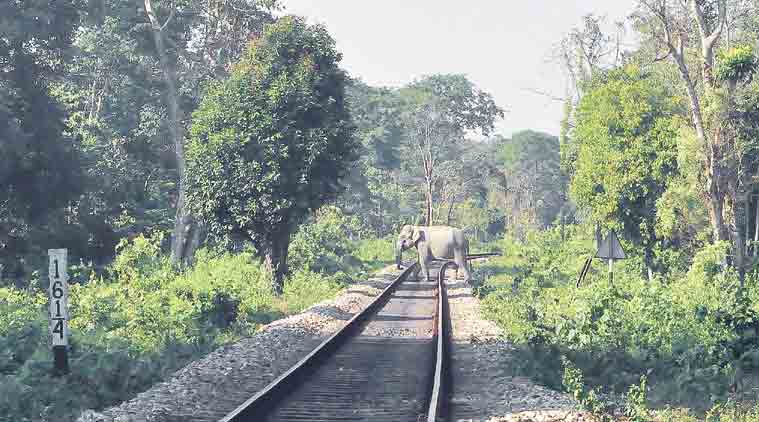
Trains have killed 15 elephants in the last 5 months. Realignment of tracks, and other site-specific, scientific remedies can make these magnificent, long-ranging animals a lot safer in the wild.

assam elephants death, elephants train accident, assam elephants accident, elephants killed on train tracks, elephants killed by train, assam news, india news, latest news, indian expressA female elephant crosses the railway track at Buxa Reserve in West Bengal. Slowing down trains has frequently failed to stop elephants from being run over. (Express Photo)
Road and rail accidents kill about 1.5 lakh Indians every year. That is 0.01% of the country’s 133 crore population. It is a significant cost to pay for the benefits of modern transportation.

Elephants have no use for roads and trains. And yet, at 10-20 deaths on tracks per year, the loss to their 30,000-strong population in India is five times higher in percentage terms. And it is getting worse every year.

A report by the Elephant Task Force, commissioned by the Ministry of Environment and Forests, estimated that over 100 elephants were killed by trains in the first decade of this century. As many as 20 were killed in 2010 alone. There were two large tragedies: 6 deaths in Odisha’s Ganjam district on December 29, 2012, and 7 deaths in North Bengal on November 13, 2013.

2016 has been a bad year — the last five months have witnessed at least 15 elephant casualties on tracks — 2 in Tamil Nadu (June), 3 in Kerala (July and November), 3 in West Bengal (August), 2 in Jharkhand (September), 1 in Uttarakhand (October), and now 4 in Assam over 2 days (early on Monday, early on Tuesday). On every occasion, locomotive drivers are accused of flouting the speed limit of 40-50 km/h in elephant corridors.

Of the 88 identified elephant corridors in India, 40 have national highways running through them, 21 have railway tracks, and 18 have both. It makes little economic sense to impose restrictions on speed or night traffic along such lengths of India’s ever-expanding linear network. Also, accidents can happen even at low speeds — due to human errors and the unpredictability of animal movement.

In North Bengal, for example, the night speed limit used to apply to only 17.4 km — a length arrived at by adding a series of short stretches of 1-3 km each in an 80-km stretch between Alipurduar and Siliguri. Since 1-3 km doesn’t cover even the braking distance, trains ran slowly over the entire distance. So it did not make a difference when the forest department extended the 17.4 km go-slow stretch to 79.60 km in 2013.

Speed restrictions are feasible only in short, singular stretches, such as the 11 km killer stretch near Berhampore in Odisha, the 8 km stretch that cuts through Jharkhand’s Palamu, or the 4 km death trap in the Palghat Gap that connects Kerala’s Palakkad and Tamil Nadu’s Coimbatore through the Western Ghats. It is not an option on steep gradients, such as Assam’s Karbi Anglong, where trains have to accelerate to climb the slope.

Speed restrictions, wherever feasible, must be guided by real-time inputs from forest staff on elephant movements to help locomotive drivers. A protocol put in place in Rajaji National Park helped avert elephant casualties for 12 long years. Followed rigorously, it still holds good, and can be replicated in short stretches elsewhere.

But where a track or road cuts across several wildlife corridors over a longer stretch, the real solution is realignment. For example, it makes little sense to restrict the speed of trains along the 80 km Alipurduar-Siliguri stretch, when there is a less vulnerable alignment available through Falakata.

Where realignment of a longer stretch is not possible — like the track that must cut through Rajaji National Park to connect Dehradun to the rest of India — we need elevated tracks with underpasses for safe, unhindered animal movement.

This requires major investment, and all forest routes across the country can’t be realigned or elevated overnight. But the Railways needs to prioritise, and consider the aspects of speed and safety while planning new projects or expanding existing ones.

It isn’t only about conservation either. Luckily, the Railways has avoided major passenger casualties so far, but collisions with elephants almost invariably damage and derail locomotives, lead to temporary suspensions of service, and impose costs on the exchequer. These considerations should help offset the cost burden of route realignment or constructing underpasses.

In the past, cost-cutting, or a lack of understanding of animal behaviour, or both, have come in the way of finding viable solutions. Given their size, elephants do not venture into narrow, low passages. They don’t climb vibrating ramps to cross a highway or railway track either. Funnelling the animals towards designated passageways is also critical because herds stick to their traditional routes.

The first recorded instance of elephants taking an underpass was in South Africa’s KwaZulu-Natal province. Then Kenya built a 6-metre long underpass, linking Mount Kenya National Park and Nagre Ndare Forest Reserve, which is being used by herds since 2012.

At home, solitary bulls occasionally used the Dogudda aqueduct to cross the Chilla-Rishikesh highway, but the matriarchal herds stayed away. Not until 2010 did we have the first evidence in India that adequately-built underpasses allowed regular herd movement.

About 35 km of NH 152 that connects Assam’s Pathsala to Bhutan’s Nganglam cuts through the buffer zone of Manas National Park. Anwaruddin Choudhury, then deputy commissioner of Buxa district, insisted on realigning the original road that ran through the core of the National Park and constructing two underpasses.

When the highway was ready in 2010, it offered two 30-foot high and 100-foot wide passageways, which elephant herds started using within months.

The solutions don’t have to be necessarily expensive. In many areas, it may be also possible to funnel elephants with fencing to designated level-crossing zones where they will not struggle to climb up or down the tracks. But site-specific, scientific remedies need to be decided upon, and implemented irrespective of the cost.

The healthiest forests, wrote the 12th century Western Chalukya king Somesvara III in his Manasollasa, were the ones in which elephants thrived, and it was the sovereign’s duty to protect those forests. Eight centuries later, in an increasingly crowded and denuded India, these large, long-ranging animals are hopelessly squeezed for space and starved of resources.

In the last three years, more than 200 elephants have died in conflict with humans across India. Another dozen or or two lost on killer tracks may not make a big difference unless we, as a nation, are serious about the future of our wild elephants.

 The Indian Express 29 November 2016

FOLLOWING THE demonetisation decision, the surge in new Jan Dhan accounts and requests for Point of Sale (POS) terminals has bucked geographical trends. While urban areas saw a sharp rise in new Jan Dhan accounts, banks have been flooded with requests for POS terminals not just from Tier 1 cities, but from semi-urban and rural areas as well.

About 6.95 lakh new Jan Dhan accounts were opened in the first week after demonetisation. Over 92 per cent of these (6.41 lakh) were in urban areas, in contrast to the trend of the scheme’s higher penetration in rural areas since its launch in August 2014. In the 12 weeks before November 9, an average of 9.20 lakh and 5.53 lakh new Jan Dhan accounts were opened every week in rural and urban areas respectively.

jan dhan, jan dhan accounts, demonetisation, demonetisation jan dhan, more jan dhan accounts, new jan dhan accounts, india news

But in November 9-16, over 3 lakh new accounts were opened in urban areas, while the number of rural accounts was down by 63,754. Even banks with limited presence in urban areas opened more than 1.12 lakh urban accounts — over three times the weekly average of the previous 12 weeks — in the first two weeks of demonetisation. Similarly, nearly 73 per cent of the new Jan Dhan accounts in public sector banks in November 9-23 were in urban areas.

The number of new Jan Dhan accounts climbed to 9.52 lakh in the second week after demonetisation. The scheme’s overall 3:2 rural:urban ratio of accounts was restored with 5.69 lakh new rural and 3.84 lakh new urban accounts in November 16-23. Meanwhile, an HDFC Bank official said they have received demands for POS terminals from places like Muzaffarpur in Bihar, Jharia in Jharkhand and several districts in North Bengal. “In places where there is a telephone connection, we are working on installing POS machines. In others, we are trying to connect them through GPRS or MPOS,” said the official.

“We have over 50,000 requests for POS pending now. The demand has gone up manifold after the demonetisation announcement,” said Rajnish Kumar, Managing Director, State Bank of India (SBI). “We are getting enquiries from urban, semi-urban and rural areas… from all the states in the country. SBI has 3,40,000 POS terminals across the country now. We expect a quantum leap in demand for POS in the coming months,” he said.

However, a banker with another leading private sector bank said the bulk of requests is still from Tier 1 cities. “In Tier 2 cities, customers are now slowly making the shift from using their debit cards to withdraw cash to using them for payments. The demand is progressing slowly,” said the official. Bankers estimate that demands for over two lakh POS terminals are pending before the entire banking sector.

STORY CONTINUES BELOW THIS AD

The National Payments Corporation of India (NPCI) said there has been an impressive surge in the usage of RuPay cards at POS terminals at shops and other retail outlets. During the first two days after demonetisation, RuPay usage on POS / e-Commerce was around 8 lakh transactions a day, compared to a daily average of 4 lakh transactions earlier.

Decoding post-demonetisation boom in the Jan Dhan balance

 The Indian Express 29 November 2016

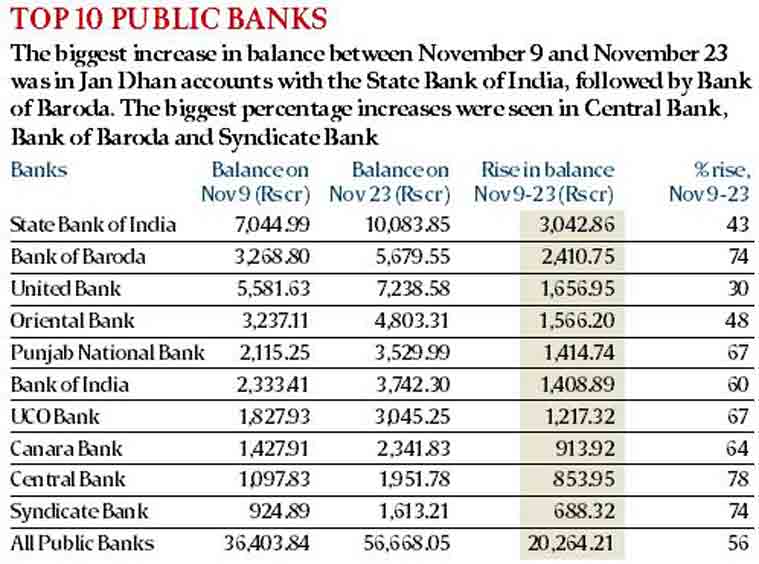
The fortnight after the scrapping of Rs 1,000 and Rs 500 notes saw a massive jump in deposits in these accounts, even as significantly fewer than average new accounts were opened.
demonetisation, demonetisation jan dhan, jan dhan accounts, jan dhan money, demonetisation black money, black money jan dhan accounts, india news, indian express newsSince November 9, the number of zero-balance accounts dropped by 4.54 lakh — a net gain of 0.33% over two weeks. (Representational)
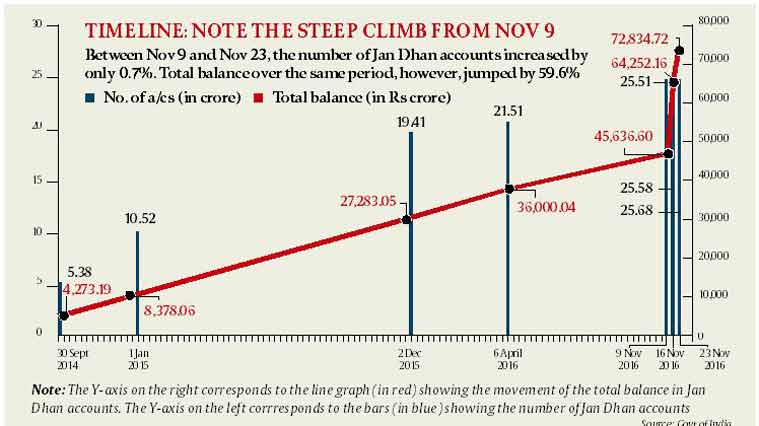
In the first two weeks of demonetisation, the total balance in no-frills accounts under the Pradhan Mantri Jan Dhan Yojana increased by 60% to Rs 72,834.72 crore. That is a jump of Rs 27,198.11 crore in 14 days. To put this in perspective, the scheme, launched in August 2014, took 16 months until December 2015 before it could accumulate a net balance of Rs 27,283.05 crore.

nsb

Given that there were also some withdrawals in these two weeks, the actual deposits are likely to have been higher, even if not significantly. Despite the deposit rush, banks were able to open 16.48 lakh new accounts in this two-week period, taking the number of accounts under the scheme to 25.68 crore. Between April and November 9, 13.28 lakh accounts were opened per week on average.

1

Since November 9, the number of zero-balance accounts dropped by 4.54 lakh — a net gain of 0.33% over two weeks. This was higher than the weekly average of 0.10% observed between April and November 9. As a result of the deposit boom, the average balance that had hovered between Rs 1,697 and Rs 1,799 this financial year, has now jumped to Rs 2,836.64.

2

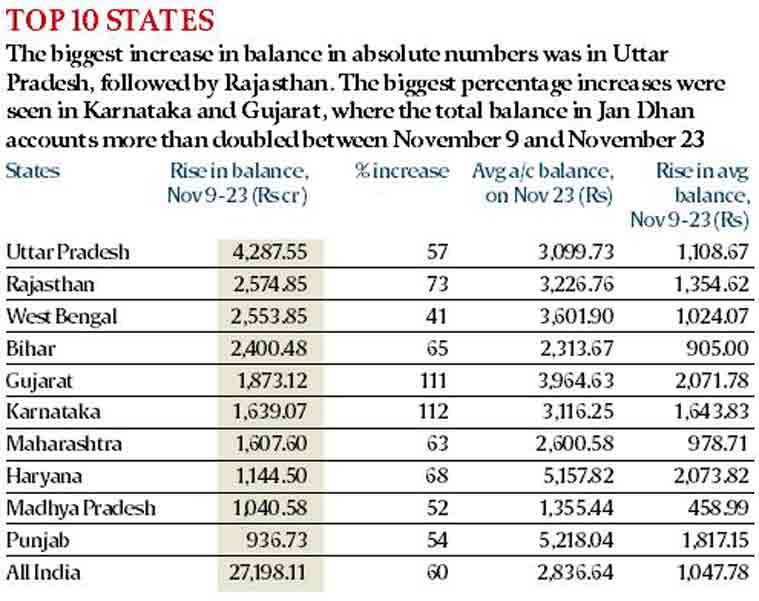
Three states — Karnataka (112%), Gujarat (111%) and Manipur (104%) — more than doubled their share of PMJDY balance in this two-week window. Rajasthan (73%), Haryana (68%), Bihar (65%) and Maharashtra (63%) also registered a jump higher than the national average of 60%. West Bengal (47%) and Uttar Pradesh (57%) recorded a less prominent swing, perhaps due to their larger account base.

3

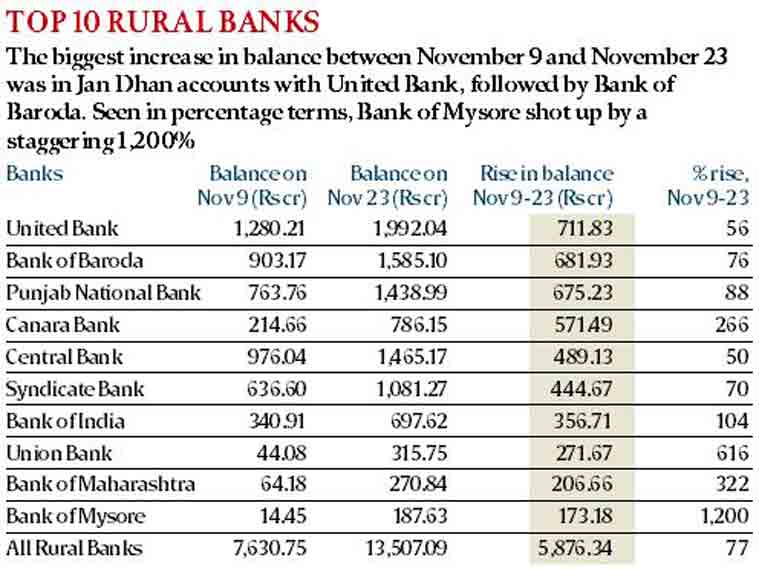
Mizoram was the only state where more money was withdrawn than was deposited — and the net balance came down by Rs 1.35 crore between November 9 and November 23. Among the larger states, Chhattisgarh recorded the least increase in deposit — Rs 401.81 crore or just 28.32%. At least 10 banks more than doubled their deposits under the scheme. Rural and private banks showed the steepest gains. Public sector banks collectively remained below the national average.

4

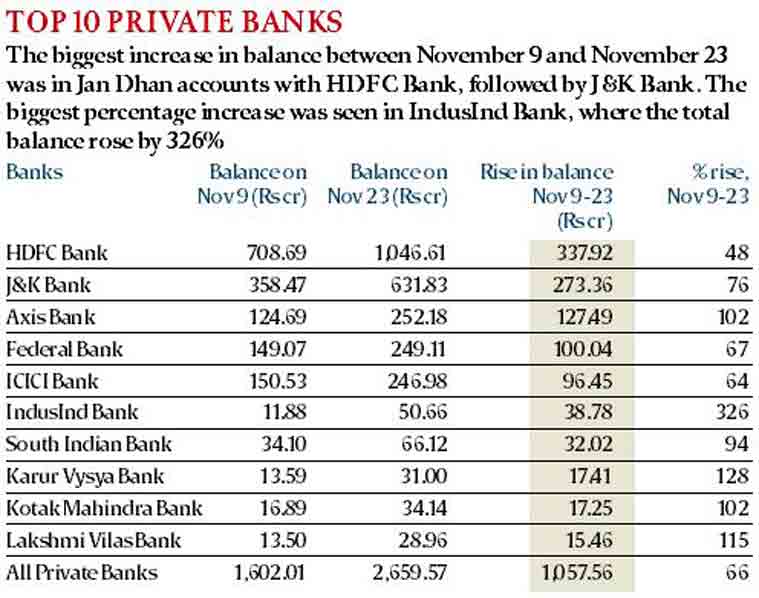
The State Bank of Mysore made the most spectacular gain in the rural regional sector with a 12-time jump — from Rs 14.45 crore to Rs 173.18 crore. Union Bank (616%) and Bank of Maharashtra (322%) followed in terms of the sharpest growth in the rural sector. Among the private banks, IndusInd (326%), Karur Vysya (128%) and Axis (102%) were the top gainers.

Why neighbourhood leopards are no threat to humans

 The Indian Express 28 November 2016

Given the space, the big cat will just slip away. But confronting, chasing or surrounding them is a bad idea, as is capturing or relocating them.

leopard, leopard killed, leopard in gurgaon village, leopard in village, leopard, leopard spotted, leopard attack, leopard habitat, animal human conflict, animal killed, latest news, indian express, india newsVillagers chase a leopard near Kustala in Rajasthan’s Sawai Madhopur district. (Express Photo: Dharm Khandal)

Last Tuesday, Delhi was thrilled to discover a resident leopard by its river. Within 72 hours, officials decided to trap and shift the big cat to Uttarakhand’s Rajaji national park or Delhi zoo. The trigger was the lynching of another leopard in Haryana’s Sohna, within the national capital region, on Thursday.

While worrying for the Yamuna leopard’s safety, officials wondered if the animal strayed from ‘its group’ and ‘natural habitat’ and if it would keep wandering far and wide, causing trouble. The media, too, described both Yamuna and Sohna leopards as ‘stray’. Some even rationalised Thursday’s mob violence as a result of the inability of the police and wildlife forces to take timely action. It is possibly rare that officials deciding on a leopard’s fate actually think that the solitary cat lives in groups (they at times form pairs though). But the perception that leopards belong to faraway forests is indeed common.

leopard, leopard killed, leopard in gurgaon village, leopard in village, leopard, leopard spotted, leopard attack, leopard habitat, animal human conflict, animal killed, latest news, indian express, india newsVillagers chase a leopard near Kustala in Rajasthan’s Sawai Madhopur district. Leopards have evolved to live near people, using secondary forests or suitable cropland as cover in the day, and walking human neighbourhoods at night. (Express Photo: Dharm Khandal)

If a leopard is found amidst people, most believe, it must have lost its way to land up there. Or there must be a forest famine that made the poor animal move out looking for food. The only remedy, they believe, is to catch the tramp and put it back in some remote forest or, if we are in a punishing mood, the nearest zoo. And if the authorities fail to do that, it’s natural that lynch mobs take over in self defence.

This perception is the problem. Animals don’t stray. Try to get rid of your house cat by abandoning it many miles from home. If it survives the traffic, it will invariably find its way back. So grant the big cat its superior awareness of its coordinates and purpose. It always knows where it is. And why.

A leopard spotted in a village cropland or city outskirts is indeed looking for food. But not necessarily because there is nothing to hunt in forests. In fact, leopards make no fuss about prey pedigree. Some may go exclusively on non-wild diet. That is how they evolved to live around people — using secondary forests or even suitable cropland as cover during the day and walking the human neighbourhoods after sunset.

With people around, there is always food. Livestock, dogs, garbage dumps. So given a patch in the vicinity to lie low during day hours, leopards will always be there among us. They are the most adaptable of all cats, big or small, and great survivors.

When we rarely create fresh cover — sugarcane fields or urban biodiversity parks, for example — leopards may get to extend their range. But with even the last few forest patches fast disappearing around towns and villages, they are actually on the run with their presence shrinking.

So if you spot a leopard where you did not expect any, like those did in the cropland of Sohna on Thursday, chances are that the animal is not a new arrival, that it — and generations before it — has always been using that space without ever blowing their cover. And without ever harming people.

Now just because it is sighted does not mean that the animal means harm. Of course, both sides will panic in such a situation. Panic triggers two responses: flee or fight. If the leopard gets surrounded by a crowd before it can slip away, which is the case most often, it will attack. There will be human injuries followed by the predictable climax in a mob-versus-one.

From Dibrugarh to Rajasthan, lynching of leopards have become routine across India. They are often hung from trees, even burned alive. Those tranquillised or trapped are no luckier. In Guwahati alone, for example, 10 leopards were captured in 2014. Of these, four died of injuries soon after. In any case, whether dead or held captive for life, it’s one leopard less in the wild.

So is catching and releasing the animal ‘back’ to a forest the solution? That is what the mob wants authorities to do every time a leopard is sighted. That is what authorities are planning to do with the Yamuna leopard as a preemptive masterstroke. Unfortunately, that is the very recipe of disaster.

Cats are territorial. If removed, they try to trace their way back to where they belong. Now imagine a leopard — traumatised by and possibly injured during capture, captivity and transportation — trying to walk hundreds of miles through unfamiliar territories and running into people it has learnt to despise. No wonder the zones of most acute conflict are around the leopard release sites.

By contrast, a leopard in its own traditional family territory is a safe bet. As a cub, it learnt the area-specific dos and don’ts from its mother. It has observed and learnt how to avoid chance encounters and when to lie low. It is familiar with the people around and their habits. If routine precautions, such as not defecating outdoors or not leaving children unattended in the open, are followed, living with a neighbourhood leopard is a lot safer than crossing the road or driving that kills around one and a half lakh every year in India.

Each of India’s at least 12,000 leopards must make a kill every week and most of them live among people, by far the easiest prey. Yet, human victims do not account for 0.001 per cent of over six lakh kills leopards make annually. Even most of those rare tragedies are of our own making — the result of capturing and translocating dozens of leopards, rampant poaching that often leaves cubs unschooled or plain bravado of lynch mobs.

If anything, their proximity to people has made leopards relatively easy meat for poachers. Estimates based on body part seizures show that on an average four leopards are poached every week.

So next time you spot a leopard, give the cat space and let it slip away. Crowd management is the most crucial primary response that help avoid injuries and save lives. Never surround the animal blocking its escape routes. A cute house cat can become a handful if cornered. Why do that to a large wild cat and then blame it?

Demonetisation: In two weeks, 60% rise in total balance in Jan Dhan accounts

 The Indian Express 27 November 2016

In the two weeks after the Centre’s demonetisation move, the total balance in Jan Dhan accounts increased by nearly 60 per cent, online data updated by the government on Saturday revealed. While the total deposit in Jan Dhan accounts was Rs 45,637 crore on November 9, a day after demonetisation was announced, it was Rs 72,835 crore on November 23 — an increase of Rs 27,198 crore.

In the first week of demonetisation, the total balance under the scheme went up by Rs 18,615 crore — nearly 60 times the weekly average of Rs 311 crore between March 31 and November 9 this year. In the second week, between November 17 and 23, the surge eased to a total deposit of Rs 8,582, still 27 times the weekly average.

As a result, the average balance in Jan Dhan accounts that hovered between Rs 1,697-1,799 in this financial year since April, has now jumped to Rs 2,836.63.

In poll-bound Uttar Pradesh, the balance in Jan Dhan accounts saw a rise of Rs 4,287.55 crore, the highest in the country. It was followed by Rajasthan (Rs 2,574.85 crore) and West Bengal (Rs 2,553.85 crore). Punjab and Goa, the other two poll-bound states, saw an increase of Rs 936.73 crore and Rs 31.06 crore, respectively, in the balance in Jan Dhan accounts.

While the increase in balance in accounts in public sector banks was 56 per cent, it was 66 per cent in private sector banks. The highest surge was seen in accounts in regional rural banks where the balance in these accounts increased by as much as 77 per cent.

The balance in Jan Dhan accounts in public sector banks rose from Rs 36,403 crore to Rs 56,668 crore in this duration. In the regional rural banks, which are subsidiaries of public sector banks in rural India, the balance in Jan Dhan accounts increased from Rs 7,631 crore to Rs 13,507 crore in this period. In private sector banks, the balance climbed to Rs 2,659 crore from Rs 1,602 crore.

According to the data, 16.47 lakh new Jan Dhan accounts have been opened in these two weeks and there has been a 0.33 percent drop in the total number of accounts with zero balance. While on November 9, the percentage of accounts with zero balance was 23.27, it was 22.94 per cent on November 23. The total number of Jan Dhan accounts on November 9 was 25.51 crore and it rose to 25.67 crore by November 23.

Sources in banks said that there were small deposits in accounts in some areas after the announcement of demonetisation as many people who had Rs 1000 and Rs 500 notes deposited them in their accounts. In certain areas, however, the deposits were huge. Last week, Minister of State for Finance, Santosh Gangwar, told The Indian Express that government is aware of these facts and scrutiny of such accounts is on.

On September 13, The Indian Express had reported based on its investigation that many branch managers were forced to put small amounts like Re 1 or Rs 2 or Rs 5 from their own pocket in zero balance Jan Dhan accounts just to reduce the total number of such accounts due to pressure from the top level.

Demonetisation: Cash-in-hand entries, dummy accounts absorb old hot cash


 The Indian Express 26 November 2016


The black market margin for ‘parking’ or ‘changing’ illegally held cash in old notes has jumped to 45-50 per cent from 25-30 per cent charged in the first week of demonetisation. The catch: Neither parking nor changing can wash the money. After paying a cut, the rest will still be in black, only in new notes. Companies with false cash-in-hand entries are raking in the money by absorbing cash in old notes from clients for a margin of up to 50 per cent. According to market sources, this has been by far the quickest channel to park large stocks of high-value old notes since the demonetisation.

“This is a golden window for those who had channelled funds as undisclosed investments and dressed up their books with large entries of non-existent cash-in-hand. They had to anyway arrange for the cash and deposit it after demonetisation. With so many illegal cash holders willing to chip in, they are now also charging a hefty commission now,” said a Hyderabad-based chartered accountant who helped clients on both sides of such deals.

“The process allows money to be parked as white in the accounts of such companies only temporarily. When returned, it will be black again. Besides, those who falsely showed high cash-in-hand in their books anyway had to find the cash to take to the bank after demonetisation. Getting too greedy or waiting for deals with high cuts may backfire if they can’t arrange for cash in time,” cautioned a lawyer in Nagpur who claimed to have brokered such deals for under 35 per cent last week.

Besides the cash-in-hand route, some companies have opted for paying advance tax on high volumes of projected profit to absorb hot cash. “It’s risky if a company suddenly claims very high profit. But if one shows reasonable, say 20 per cent, surge in the books of hundreds of dummy companies, a lot of cash can be absorbed without necessarily alerting the authorities,” explained a chartered accounted based in Delhi.

Some are confident that they will be able to deposit old notes throughout the financial year. “Old notes being still accepted in fuel outlets, medicine and seed shops etc, there is no reason why a company can’t take old notes to banks till March 2017 as long as it can justify the source one way or the other,” claimed a Mumbai-based operator offering to park “unlimited old notes” for a 50 per cent cut.

The more elaborate means to park old cash is depositing up to Rs 50,000 each in hundreds of basic accounts under the Jan- Dhan Yojana. But it requires large networks to channel any substantial amount and may not escape the government’s radar, particularly if dormant accounts are used.

Instead, what has gained popularity among the hot cash holders is the parking service provided by a section of accountancy and trading firms who control hundreds of dummy demat accounts created for distributing dividend.

“We always had such accounts and also opened in bulk when the share marketcrashed a few months ago. Each dummy demat account is linked to a dummy bank account created with identity cards of mostly migrant workers without their knowledge. These are all doubling up now as parking accounts,” claimed a Bengaluru-based chartered accountant who offered to “settle any amount at Rs 2.5 lakh per account” for a 45 per cent commission.

“Unlike Jan-Dhan accounts, the advantage with these accounts is three-fold. First, these were already being used for trading and are not non-operational accounts with little or no balance where sudden cash flow would raise eyebrows. Second, you can park five times the money in each account. Third, the eventual withdrawal process will be a lot more organised,” explained a partner in a Kolkata CA firm that offered “more than 500 accounts for 40-50 per cent” depending on the transaction volume.

But even short-term parking of hot money requires trust. For those looking for immediate exchange, many intermediaries have entered the market and are pocketing an additional margin of up to 10 per cent.

“We are getting many new clients looking for on the table exchange. Few of them can contact the actual operators. Going through an agent keeps them insulated and makes it easy,” explained a Ghaziabad-based agent who offered to change up to Rs 3 crore daily “anywhere in South Delhi” at a 35-40 per cent margin.

Some of the agents The Indian Express could contact did not require a pre-introduction and were upfront and competitive about the services on offer. It all depended on their ability to generate “false white entries” in their accounts and their capacity to draw new notes far above the daily limit in arrangement with certain banks.

A Bengaluru-based “transport provider” who identified herself differently as Swetha and Saraswati to different clients, offered the service for “30-plus-10” per cent commission. “Our companies have paid advance tax. Then, there is white income from properties. We can do up to Rs 5 crore daily till mid-December but you have to tell us a day or two in advance. We have done for local clients but people are also coming from Hyderabad and Chennai,” she claimed.

The options on offer are simple:

If a client has “receiving capacity”, money will be transferred from a company account through RTGS as soon as the client deposits old notes in that account. An agent who offered the service on behalf of a “big leather company” claimed that the staff at two private bank branches in Bengaluru “have been paid off” to beat the “queues and chaos” at deposit counters.

Within 24-48 hours of striking a deal, the agent brings new notes — mostly 2000s, some also offer a limited number of 500s on demand — to the client at a safe place, usually a hotel room. Checking and counting old notes can take up to six hours depending on the amount before the new notes are handed over.

“The risk of carrying bundles of old notes is nothing compared to moving so many new notes. Yet, we are ready to bring the cash to any private place of your choice. Once you exchange, the new notes are your liability. High-value currency in smaller size is easier to handle. But I can also organise a safe transporter for an extra 2-5 per cent if you require,” said an agent who operates in Mumbai and Goa.

A Hyderabad-based agent who identified himself as Sanjay, however, discouraged shifting cash long distance. “Changing Rs 5 crore won’t take long and you can go back to Delhi the same day. But trains are risky these days and it’ll be a very long drive,” he cautioned.

The cuts are set to soar though. “If you confirm the amount now, we will offer you this rate (40 per cent) for the next three days. After that we will charge current market rate. If you delay, the cut may go up to 60-70 per cent by the end of the month,” warned the Bengaluru-based agent.

Spotted a leopard? Back off, stay calm, let it slip away

 The Indian Express 26 November 2016

Leopards traditionally live close to people and just because one is sighted does not mean the animal means harm.

Yet again, a leopard was lynched. This time in Haryana’s Sohna. While frowning on the beastly act of the mob, the media, without exception, described the animal as one that strayed from its natural habitat. Some even rationalised the violence as a result of the inability of the police and wildlife forces to take timely action in a situation of man-animal conflict.

The real problem is with this perception. Leopards do not visit people looking for food because there is a prey crunch in the forest. And they certainly do not stray. Unlike tigers, many leopards are fringe-forest animals. They live near human habitations, use secondary village forests or even suitable cropland as cover during the day, and walk the human neighbourhoods in the vicinity after sundown. They opportunistically prey on small livestock. And they take dogs, domestic or pariah, their favourite prey. There is no dog in the forest.

Like that, over centuries, leopards have adapted to survive next to people without major conflict. If you happen to spot a leopard in the cropland of your village, like some did in Sohna yesterday, chances are that the animal — and generations before her — has always been using that cropland without ever blowing their cover. And without ever harming people.

(Source: Photo by Manoj Kumar)(Source: Photo by Manoj Kumar)

Now just because it is sighted does not mean that the animal means harm. Of course, both sides will panic in such a situation. Panic triggers two responses: fight or flee. If the leopard gets surrounded by a crowd before it can run away and disappear, which is the case most often, it will attack. There will be human injuries, often grievous but rarely fatal, with the predictable climax in a mob-versus-one.

The one and only rule to avoid conflict in such situations is to give the cat space and let it slip away. Don’t create a ruckus and never crowd around the animal blocking its escape routes. Instead of depending solely on tranquillising guns, nets and cages — which become necessary in tricky conditions — cops, wildlife personnel, volunteer groups and community leaders can help avoid injuries and save lives by following this simple protocol as the primary response.

Letting the wild be is a time-tested strategy. There is no excuse, other than our increasing sense of insecurity, for abandoning it.

Demonetisation: Last fortnight, over 30 times surge in Jan Dhan deposits; maximum from Bengal and Karnataka

 The Indian Express 24 November 2016

Pradhan Mantri Jan Dhan Yojana accounts have seen deposits surge almost 30 times by around Rs 21,000 crore in just 14 days since the government’s November 8 announcement on the withdrawal of high-denomination currency notes, government sources said on Wednesday.

According to these estimates, the average weekly deposits in these accounts rose by 3,200 per cent in the two weeks since November 9. Between March 31 and November 9 this year, the weekly deposit average in Jan Dhan accounts was Rs 311 crore, which increased to Rs 10,500 crore in the past two weeks. In effect, it should have taken roughly a year for banks to get the amount of deposits that came in during the past fortnight.

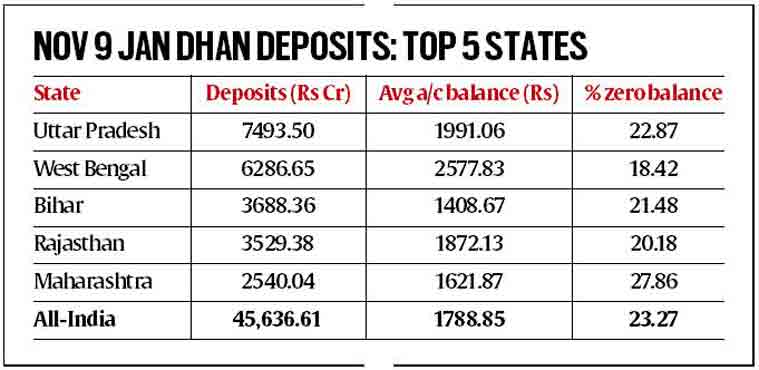
While the amount of deposits that came into accounts in West Bengal and Karnataka — two states, government sources said, have shown a record surge — over the last 14 days was not known, according to latest data updated until November 9, West Bengal had the second highest amount of deposits of Rs 6286.65 crore in Jan Dhan accounts.

aa

Uttar Pradesh topped the deposit list with Rs 7493.50 crore of funds in these accounts and 22.87 per cent zero balance accounts. Karnataka had deposits of Rs 1456.96 crore in Jan Dhan accounts as on November 9. State-wise details beyond November 9 are awaited.

Since the launch of Jan Dhan in August 2014, total deposits into these accounts were Rs 45,636.61 crore as on November 9, 2016 — the day the government’s currency withdrawal decision kicked in. Total deposits in Jan Dhan accounts jumped to Rs 66,636 crore as on November 22.

With less than 10 per cent share in the Jan Dhan network — 2.44 crore out of 25.51 crore accounts — West Bengal already accounted for nearly 14 per cent of the scheme’s total deposits. The average balance in Jan Dhan accounts in West Bengal at Rs 2577.83 was also the third highest among the major states after Punjab (Rs 3400.88) and Haryana (Rs 3084). 

The Finance Ministry, officials said, is monitoring the sudden surge into these accounts with some officials saying black money operators could be using these accounts to convert their funds. Jan Dhan accounts have a deposit cap of Rs 50,000 per account. As of November 9, the national average balance in a Jan Dhan account was Rs 1788.85 and the percentage and 23.27% of these accounts were zero-balance accounts.

The Reserve Bank of India had in May warned that these accounts are vulnerable to fraud and identity theft with miscreants using others’ accounts to convert their illegal wealth. Sources said the finance ministry has advised banks to ensure that the Jan Dhan accounts strictly comply with the KYC (know your customer) norms.

Finance Minister Arun Jaitley said last week that the government was looking into sudden “popping up” of money into zero-balance Jan Dhan accounts. “We are getting some complaints that suddenly monies have popped up in the Jan Dhan accounts, so there is a misuse and that is why the rationing in initial days takes place,” he had said.